Specification
- Function
- Effects
- Width
- 4 HP
- In rack
- 1
- Built
- 2026
- Status
- Built
Build files
- Sub Oscillator Schematic
Effects · 4 HP
Sub Oscillator
A simple pulse wave sub-oscillator with voltage controlled wet / dry mix.
While I was browsing Eddy Bergman’s website a while ago, I saw his build of a sub oscillator and immediately thought, I need one of those! A sub oscillator is a quick and easy way to fatten up the bass of your VCO and get a fuller sound in the low end. As a secondary consideration, I had a 4 HP space next to my VCOs which could be filled, so that decided the panel size I was going to use.
Eddy’s design is taken from the Thomas Henry VCO Maximus and has the ability to transpose down one or two octaves, at either a full octave or a fifth, and the ability to flip the polarity of the signal before mixing it back with the original pulse wave. The original design uses a potentiometer to mix the original and transposed waveforms together, but I thought “Why not add voltage control to the mix and allow it to be modulated?”.
To add voltage control to the mix, I borrowed the same mixing circuit that the Music Thing Modulars Reverb uses and I copied in my build of a reverb module. This uses a vactrol (old school) to mix the wet and dry signals with voltage control. Since it’s vactrol based, I’m getting an exponential response for the mix signal which takes some getting used to, but works with patience.
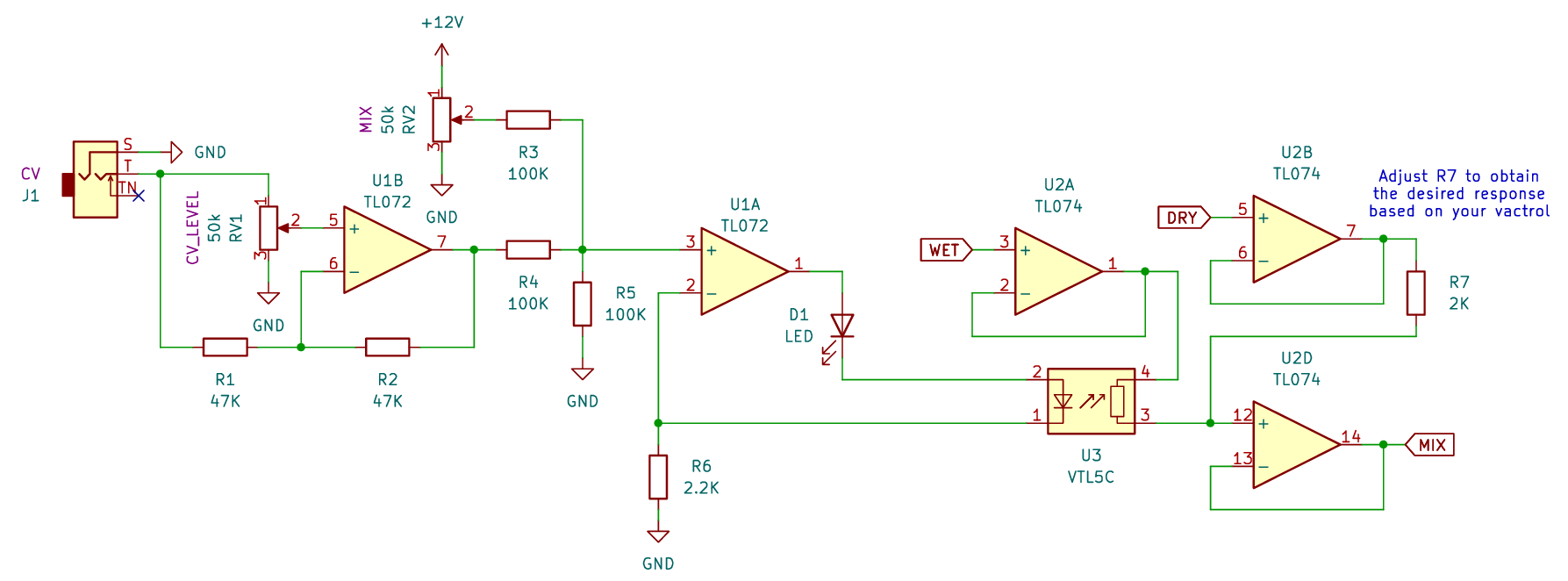
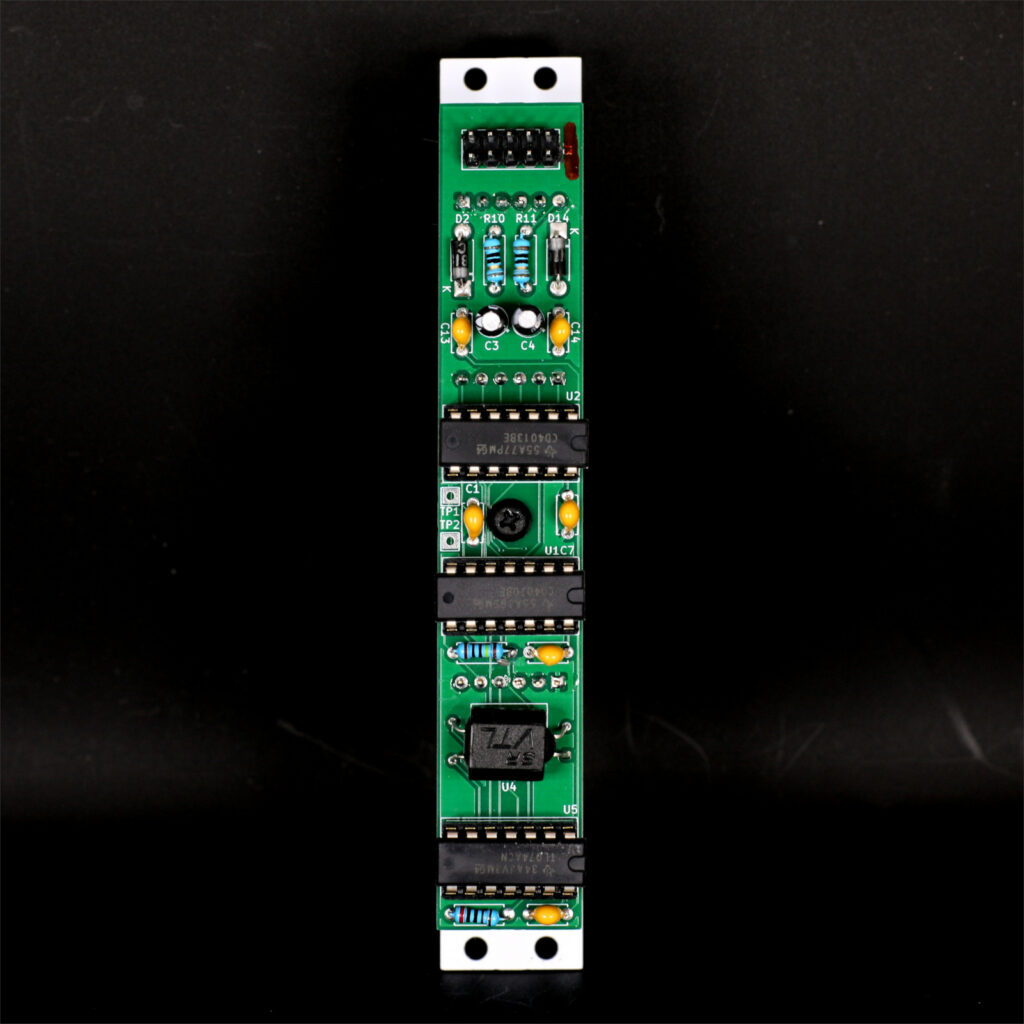
After adding the extra knob for the CV input attenuation, I was getting a bit short on space, so I omitted the polarity option from the sub oscillator design to keep everything within the 4 HP width I wanted. Component spacing on the PCB was a bit tight with the added op amps, so the build uses a mix of surface mount and through hold components in order to fit everything on to two PCBs.
After sending the PCB design off for production, I realized that I forgot to indicate the polarity on the power header. Red marker to the rescue!
Otherwise, it was easy to build and worked on my first try.