Specification
- Function
- Clock, Low Frequency Oscillator, Sequencer
- Width
- 52 HP
- In rack
- 1
- Built
- 2026
- Status
- Built
Build files
- Drum Sequencer Schematic
Clock, Low Frequency Oscillator, Sequencer · 52 HP
Drum Sequencer
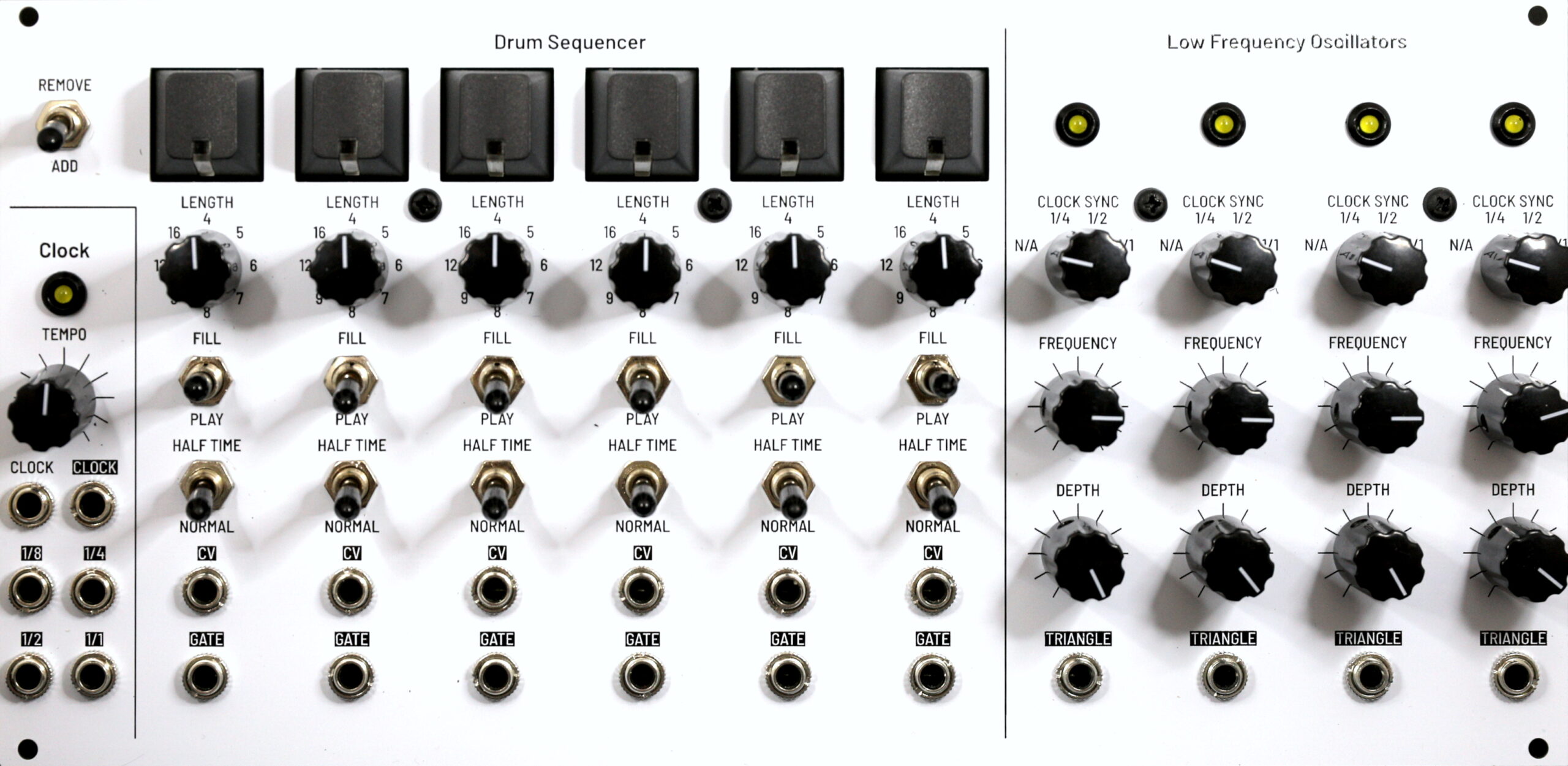
A six channel analog drum sequencer with a clock and four synced low frequency oscillators.
Moritz Klein rightly pointed out in his Drum Sequencer build that shift registers were essentially drum (or gate) sequencers waiting to happen. I had a look at his design and thought, why not more? What if I expand his design to be:
- Six drum channels (instead of four)
- Each drum having eight sequence lengths to choose from (instead of three)
- Four low frequency oscillators (instead of two)
- Each low frequency oscillator having three clock divisions to sync to (instead of two)
- The clock having five different time divisions output (instead of three)
…and I also added a switch to each drum channel to toggle between normal playback, mute, and outputting a string of sixteenth notes (fill mode).
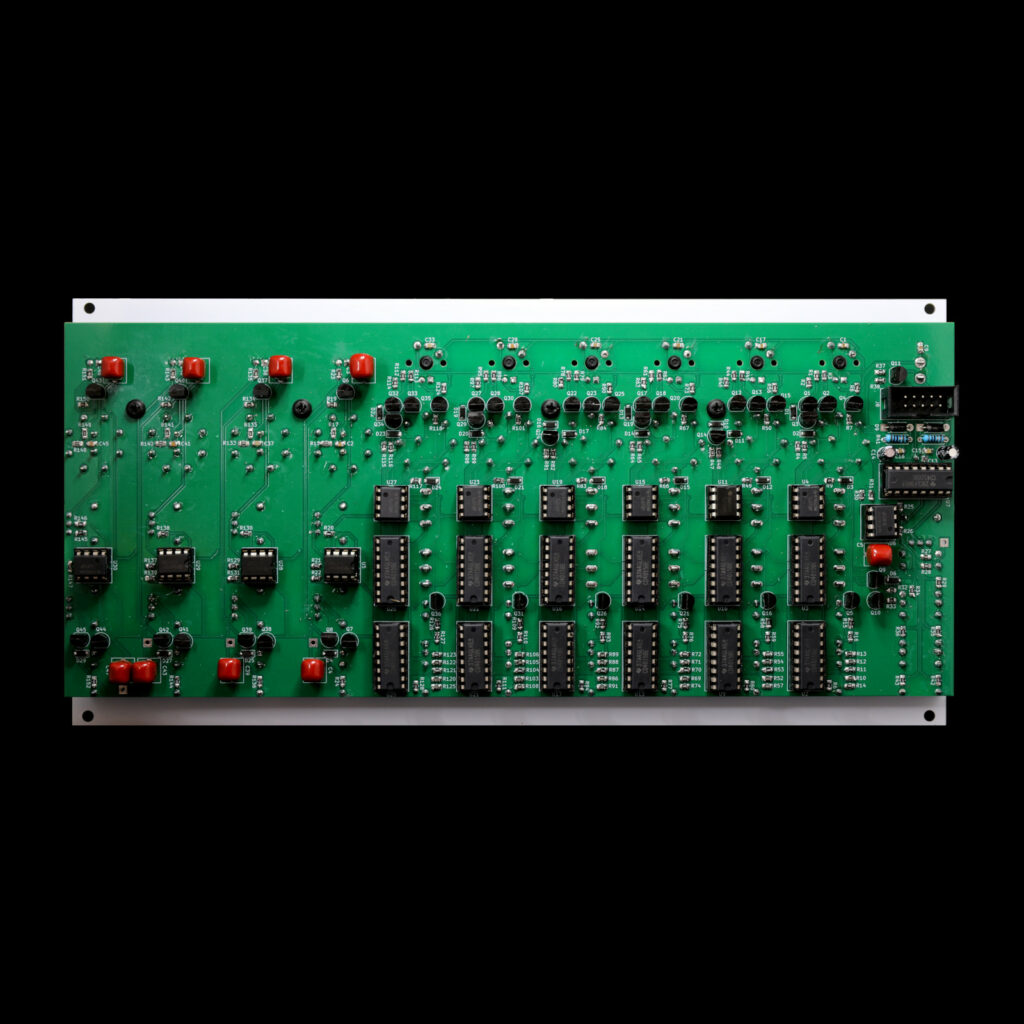
The actual method of operation is pretty simple. Each drum channel is two CD4015 shift registers set up in a cascading configuration. The step length rotary switch determines which step loops around into the input of the first shift register sequencer. The sequence loops around, unless the trigger button is pressed. Then, depending on how the switch on the far left is set, it will either add a beat or clear the current beat.
A switch controls whether the shift registers increment every sixteenth note (normal mode) or every eighth note (half time mode) for longer sequences at the expense of only being able to play on every other sixteenth note.
The clock is a fairly simple square wave oscillator which is fed into a CD4520 clock divider that creates divisions which equate to eight notes, quarter notes, half notes, and whole notes. The CD4520 clock divider is pretty nifty since it scales the square wave so that each of the longer divisions are also square waves (so the quarter note is ‘on’ for an eight note and ‘off’ for an eight note each cycle).
This is by far the largest build I’ve attempted, so I prototyped the module initially with the clock, a single drum channel, and a single low frequency oscillator and I scaled up the design once I confirmed that everything was working as expected. Now that the full version is built, I’m really happy with how this turned out.